Showing posts with label university. Show all posts

Dear December, nineteen to twenty-two: lumiere.

Tuesday, December 22


It's the winter solstice today, so: the shortest day and the longest night of the year. I'm sitting by the window just now and I can tell you: it's pretty dark out there. The solstice also signals that autumn is over and winter is here. It has officially arrived. If it’s anything like last year, I know it’s going to be cold. Cold, and dark, and rainy, and biting. I’ll need to stock up on hand-cream. I should really buy an anorak. The underbellies of my fingernails will no doubt soon be filled with frost from the windscreen, my fingers stinging from the spray of the can, the click and shake and the ice dissolving.

But even so, I can’t help letting out a small sigh at the thought of it: Thank God, that’s it. The worst of the darkness has been now (...right?) Light will be coming back. It might take a while, yes. The sun will continue to disappear mid-afternoon. My breath will turn to cloud on my walk into uni and there will be days where not even steam from the bath will be enough to melt the shiver in my bones. At times, the idea of ‘anything other than this’ will seem impossible. I know that. I know it. It's been like that all autumn. I’m bracing myself. 


But even if it comes slowly, inch by inch, it is coming. The darkness has been: the light is coming back. It will come back. (These are words to repeat on heavy days: It will come back. It will come back. It seems dark now, but light will come back.)


Related to light: these (slightly fuzzy iPhone) pictures are from the Lumiere Festival in Durham back in November which I've been meaning to post for a while.  I was there for a weekend, giving my first ever (joint) conference paper (on 'fostering originality in student writing') at the National Association of Writers in Education conference ...and this quite, quite breathtaking festival of light happened to be taking place in the city at the same time. I’ve never seen anything like it before: both beautiful and eerie. Moving light installations all along the river, projections beamed onto the side of the cathedral and castle walls, double decker buses lit from the inside, street benches glowing. It felt like we’d stumbled into a city under enchantment.


Snatches from the weekend: walking round the streets and along the river in the dark - rain hammering down, seeping through my hat into my hair - but not feeling afraid. My heart in my throat. Moving images – stars, numbers, planets, stained glass figures – sliding up and down and along the sides of the cathedral. Standing on the grass, mud underfoot, eyes wide, and music surrounding us: so loud and drumming and achingly beautiful that I could feel it inside my veins. 


Sitting on a pew inside the cathedral for a few moments, arching my neck back, back, back to stare at the light lines moving, twitching, above our heads. Sitting quiet. Discordant choral music playing underneath the squeaking of boots and wet jeans slapping together as the crowd moved closer, forward, forward, towards the alter with gripped iPhone cameras. (‘How does it make you feel?’ Looking up at the light. Holding my breath, the lines shivering. Unsure how to put it into words. ‘Unsettled, I guess. Uneasy? There’s something kind of unsettling about the movement, isn't there?').

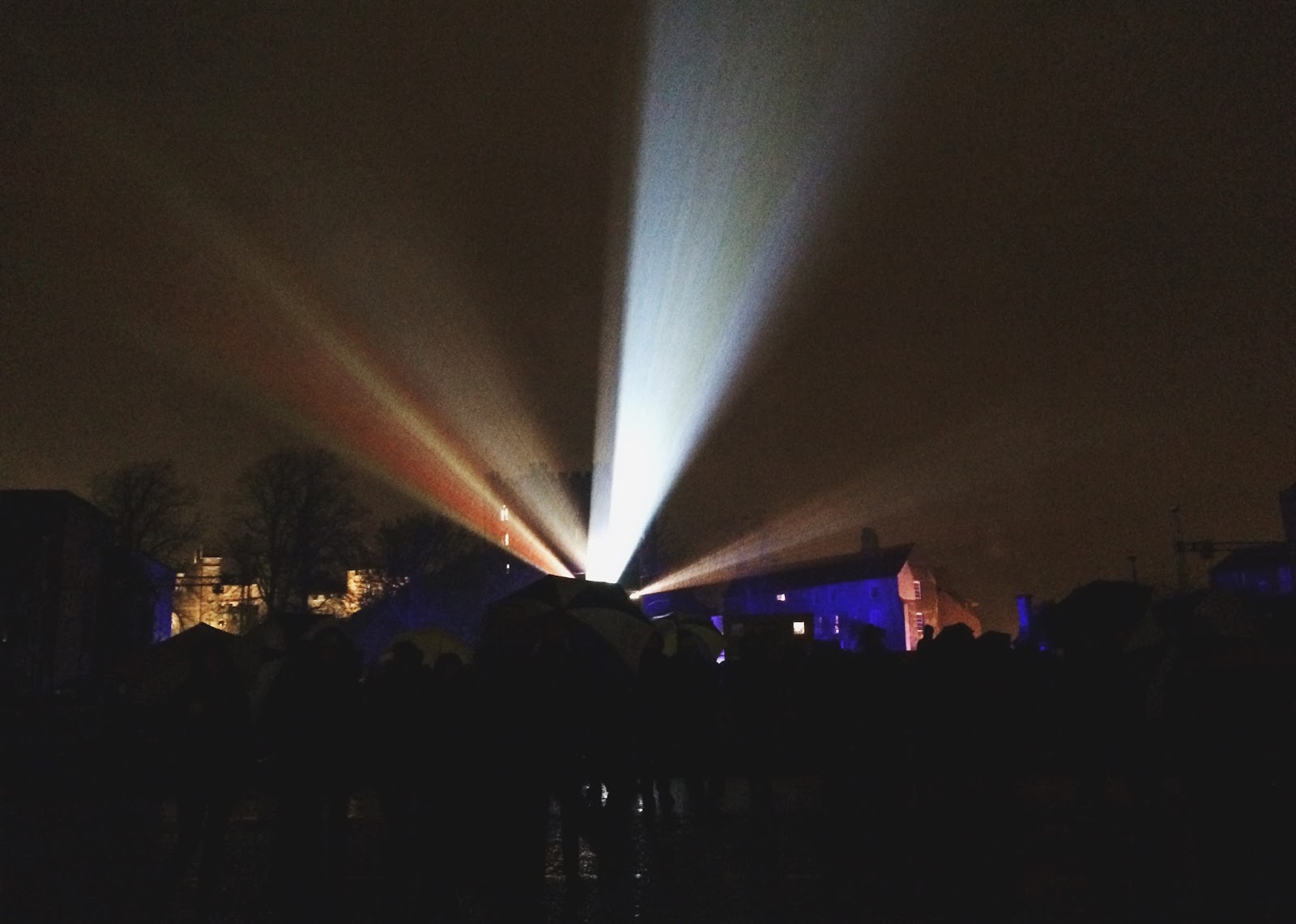


‘Do you want to light a candle?’ Thinking of Paris*, but unsure what to pray. Back outside and following signs for ‘fog this way’. Rain catching in the light, putting on a show itself. Twinkle lights strung up along the water's edge and then: the Fogscape. Fog pouring down the hill on the other side of the river, pushing through the trees, spilling onto the water, stretching closer and closer towards my shivering fingers like a spell had just been whispered. 

(*the conference and Lumiere took place over the weekend of the Paris attacks - and also the weekend my grandfather passed away - which made the rain feel more chilling, and the light seem more important.)  


Song a day 

Saturday’s song: The Wisp Sings by Winter Aid. Sunday: Believe by Mumford and Sons (though I've actually been listening more to Only Love but can't find a good version online. Buy it). Monday: In Dreams by Ben Howard. Today: Allegri's Miserere (part of which was played during the festival.

p.s. // Technical question: I'm testing out changing the font on the blog. What do you think of this? I've been trying to figure out an alternative for 'Courier' for years... but all other fonts seem either too big or small for blogspot (and I can't figure out how to adjust size to anything between 'normal' and 'large' on here). Comments appreciated below or you can send me a note on my facebook page.

the end of term.

Thursday, April 9

For the past ten Mondays, I’ve been teaching a first year undergrad creative writing class. It’s been amazing, and kind of surreal* ...and that’s the semester finished now. [Insert comment about how quickly time passes]. On the final day of class, none of the students stood on their desks to say O Captain! My Captain! (alas). But I quite enjoyed teaching them. Hopefully they learned a few things


The class was on the foundations of fiction, so we talked about things like: characters need to want something (that they can’t easily get) in order to be compelling; stories without conflict aren’t really stories; conflict doesn’t necessarily need to be uber-dramatic, sometimes silence says more than shouting. We talked about setting and how to involve the reader in the world of a story by building a strong sense of 'place' (which doesn’t generally mean: write a ginormous paragraph describing the surroundings in precise geographical detail. More often it means: drop in a few ‘telling’ sensory details – the dust specs that catch in the evening light, the peeling paint on the walls of the bedroom, the metallic heart-beat sound a train makes when it’s rumbling over a bridge – and then leave room for the readers’ imagination to fill in the rest).


‘The job of a writer,’ I kept telling them, ‘is to capture (or try to capture) in language what it feels like to be alive. And to do that – you need to practise the art of paying attention.’

Write down the details. Write down the conversations you hear on the street. The strange words people use. The way light hits the trees on your walk home. Work out what that taste in your mouth is when you hear bad news. Write it all down. Pay attention to it all.


Pay attention to your life. Pay attention to your life.

They probably got a bit sick of me saying that. But that – aside from the unglamorous task of sitting down and just getting on with it – is the most important thing a writer can do, I think** (perhaps one of the most important things a person can do). It’s something I’m continually trying to teach myself. I go on about it an awful lot, but I keep forgetting to do it.


Footnotes:

*It was surreal because: it was only five years ago that I was a nervous 18-year-old going to my first creative writing workshop, not imagining that a few years later I’d be up the front teaching one. (When you’re quite unambiguously introverted, standing for two hours in front of a group of twenty students every week is a definite leap out of your comfort zone. But a good leap, I think. I would like to keep doing it).


**Probably the first place I came across this idea – that writing is about ‘seeing’ and ‘paying attention’ – was in an essay on writing by Kate DiCamillo which I read over and over as a young teenager. 
‘What I discovered,' DiCamillo writes at one point, ‘is that each time you look at the world and the people in it closely, imaginatively, the effort changes you. The world, under the microscope of your attention, opens up like a beautiful, strange flower and gives itself back to you in ways you could never imagine...’ 
It’s a really beautiful essay – whether you’re a writer or not. You can find it: here. I read it out to the class before they packed up their bags on the last day.)


Pictures are by Clare Elsaesser. You can find her: here.

some things I'd rather be doing right now

Tuesday, February 17


I’d like to have a wheely-chair race round this building
I’d like to try on five blue dresses and twirl a few times
I’d like to play music very loud and dance in the kitchen
I’d like to jump on a trampoline (without injuring myself in the process).

I’d like to sit in Kibble Palace and eavesdrop other voices 
I’d like to sift through old postcards and imagine who they’re from
I’d like to write long, long letters without stumbling over syntax
I’d like to draw little pictures and colour them in.

I’d like to get on an airplane for that feeling of almost-being somewhere
Holding my breath as it starts to go down.

I’d like to paint on a banner all the words that I’m liking
Punctuate. Whisper. Consortium. Tulip.
I’d like to eat summer strawberries or bonbons or peaches
I’d like to click open coke cans – but just for the sound.

I’d like, if I could, to get a big feather duster and
break up this cloud lurking, dull, by my head:
              it's 

              turning the shade of my skin 
              grey, and the curve       of my lip     
                 grey
                  and the tone of my voice 
             grey,           and my greeny-brown eyes 
                       grey.

But –
I’d better get back to work.


(Ps. I'm looking forward to the Spring. Pps. This isn’t really meant to be a poem. It’s more of a structured list written when I should be doing other things. Ppps. Kibble Palace, if you don't know, is the beautiful lacy glasshouse in Glasgow's Botanic Gardens, pictured: here.

And also: Sorry for the silence on here. I’ll return when the workload allows...

Picture by the very talented: Julianna Swaney. Her pictures always fill me with light.) 

forbidden music.

Thursday, November 21

It’s late when I leave the library tonight. By the time I finish writing and gather my notebooks together – stuffing them inside my backpack – the moon is out, the streetlamps are on, the campus is quiet. Pulling my scarf close to my skin, I hurry along the street, towards the coffee-shop where I’m meeting a few classmates to discuss a literary journal we're putting together.
               
It is freezing. A woman waiting at the bus stop in front of me tries to light a cigarette. She shields the flickering flame with her cupped hand until - a flash, a flash – it’s lit. The smell of smoke winds towards me as I turn the corner, heading down the hill towards George Street. Red and white lights from cars speed past. Their reflections bounce onto, and then slide off, the black walls of the building on my right.

 
Men's voices, a little way behind, on the other side of the street, start shouting – swearing at each other. Instinctively, my fingers fasten around the phone in my pocket. I start to walk faster, trying heat up. But this air is icy. From the train into Glasgow this morning, I noticed snow on the mountains, and now my knuckles are stinging. My nose is stinging. My neck.

It’s because of this – the cold, the creepiness, the dark etc – that, when I see the lights are still on in the building beside me, I move towards the door and – pushing it open, my wrists clicking a little with the weight – slip inside. Warm air on my cheek. Dim yellow light. The door swings shut behind me, muffling the sounds of the street.


This building – I start walking again, slower now, not feeling such a need to rush – joins into one of the oldest buildings in the university. I walk past the front desk – it’s empty – down a small flight of stairs, through a set of double doors, and I’m here: the Royal College. 

Stone staircases, marble tiles, stained glass windows, peeling wallpaper – this building has always been my favourite in the university, because of the stories it seems to whisper at. If I go down enough levels, if I take the right turnings along its labyrinthine hallways, I know I can leave the building on the ground floor. That’ll take me out to George Street, and keep me out the cold for a while. Brilliant.


I start heading down a long corridor lined with dark blue lockers. My shoes squeak as I walk. The lights seem duller than usual. I glance behind me, biting my lip. Usually there’s the sound of footsteps in this building, the conversation of cleaners, the odd “mad-scientist”-looking lecturer darting about in a white lab coat. But – I check the time on my phone – the place is deserted. I’m starting to wonder whether I’m even supposed to be in here this late when, all of a sudden, I hear something. I stop walking. I listen, frozen to the spot.

Music.

There is music coming from a room close by. I hold my breath, trying to catch the sound. Piano music. It keeps stopping and starting. Someone seems to be practicing. All thoughts of ‘am I allowed to be in here?’ vanish as curiosity takes over. Where is it coming from? I start walking again – my heart beating a little faster – moving in the direction of the song, following its sound. It leads me along a narrow corridor and up to an enormous wooden door.


I tiptoe closer, vaguely aware that if someone were to catch me, to open the door suddenly and - blinking, furrowing their brow - find me, lingering here, I would be stuck for words. I wouldn't know what to say, how to explain myself... 

I put my ear close to the wood. It’s definitely coming from inside this room. The door is ajar, and I peek through the crack, trying to see inside. I can’t see much: a high ceiling, a balcony, wooden floors, long rows of desks laid out. It looks like it’s set up for an exam. In fact - a memory triggered - I think I had a Victorian Literature exam in this room a few winters ago. But I can’t remember there being a piano in the room. I still can’t see it. The musician remains hidden.

I stay here, in this dark hallway, for quite a while. A line of yellow light slipping out from the doorway, landing on my shoe. A warm glow growing inside my chest. I stand here, just listening. Just being.


When I head back out into the night, I can’t seem to stop smiling. The cold doesn’t seem so biting. The dark a little less ominous. I can’t put my finger on what it is about this small discovery that has made me so happy. But that’s how I feel. Happy. Quite inexplicably happy.

It feels as though I’ve stumbled across something important. Something beautiful. Something secret.


(*p.s. A tiny clip of the music is meant to appear above these words. If you're reading this on mobile, find it by clicking: here. 

Pictures by Yelena Bryksenkova. The dreaminess in her pictures kind of links in with the words...)


(Follow my blog with Bloglovin)

wild dreams of achievement

Monday, September 30

‘...it occurs to me that there is a proper balance between not asking enough of oneself and asking or expecting too much. It may be that I set my sights too high and so repeatedly end a day in depression. Not easy to find the balance, for if one does not have wild dreams of achievement, there is no spur even to get the dishes washed. One must think like a hero to behave like a merely decent human being.’
~ from May Sarton’s ‘Journal of a Solitude’ (1973)

I came across this passage this afternoon and oh yes, I know what she’s talking about.  

I’ve started studying again, this time as a postgraduate student (I’m doing* a Creative Writing Master of Research: quite exciting). I’ll need to learn how to make realistic writing plans over the next few months. I tend to be ridiculously ambitious and then beat myself up later for not achieving the impossible.

*Note: ‘“doing” a Creative Writing Master of Research’ sounds a bit clumsy, but I thought “undertaking” made it sound a bit grandiose. Ah, language: it's a tricky thing. And here I am, trying to dance with it.

(Picture taken one hot summer night this July.)

if not always.

Monday, July 8

So, quite a lot has happened since May 16th. Good things like: I've been halfway across the world (in Atlanta, Georgia, with the most lovely, kindred-spirit sort of friends - pictures from this adventure later). 


...and, more recently, I graduated from the University of Strathclyde (I'm now the proud owner of a BA in Journalism and Creative Writing and English with first class honours! A bit of a mouthful, but I'm so pleased. Here's lots of pictures of me with assorted Reids to prove it actually happened: it all feels a bit surreal).  


A few not-so-good things have also happened. Are happening. Along with the usual ordinary small life-things that make up most days. Eating dinner, going to bed much too late because of reading, working in the cafe, navigating round-a-bouts in the car, savouring the  sun when it's out, conversations, getting older (I turned twenty-two this week: an age that sounds quite like an adult's).


But here endith the news update (slash explanation for why I didn't post in June). I'll leave you with a small (to my knowledge untitled) poem by Kate DiCamillo, the last few lines of which have been waltzing around in my head recently.  

Take a breath. Listen. Now read.

a poem - by Kate DiCamillo

My favourite six letter word is
always
because it promises
so much.

My favourite five letter word is
never
because it insists on contradicting
the promise.

My favourite four letter word is
once
because it says it
happened then
.

My favourite three letter word is
yes
because I’m just now learning
to say it
to my heart.

My favourite two letter word is
if
because it makes
all things possible
like this:

If not always
If not never
Then once.

Yes.

I was once a tall tree

Friday, April 26

I noticed this toilet-door graffiti in the Mitchell Library in Glasgow*. There were the usual graffiti suspects scrawled over the door (e.g. ‘Yer maw!’ or ‘Lucy + Gregg 4eva!!’ [enclosed in a crudely shaped heart] and so on), but I liked how a few of these were quite poetic (and uplifting). I've never met anyone who has admitted to writing on toilet doors. I wonder what gives people the urge to do it:

('If you are reading this then be happy. 'Cause, hey! You are alive')

('One day you will be loved the way I am. You deserve it, trust me.')

('Choose life.')

('I was once a tall tree/I was once a child')


*Incidentally, I was at the Mitchell Library during the Aye Write! Festival – a wonderful book festival which runs every year over a few weeks in the spring. Over the past few years I’ve heard lots of interesting writers including David Aaronovitch, Germaine Greer, Julian Baggini, Susie Orbach, and others. (I’ve yet to go and hear a poet or a novelist. This will be a must for next year...)

The evening these pictures were taken was quite exciting as, rather than going to listen to a reading, I was actually giving a reading along with two other students from my year at university. (I’d received an award for a piece of flash fiction as part of Strathclyde University’s writing completion: the Keith Wright Memorial Award, judged by Ewan Morrison.) An amazing – if slightly nerve-wracking – experience! My first ever public reading, and also the first ever time I've been given a spot of money for a piece of writing. 

the final countdown.

Wednesday, April 10


Here's three funny little pictures for you to chuckle about (by the very most wonderful Marc Johns: his pictures crack me up) while I sit in my room, typing madly, panicking slightly, trying to blast through two 3000 word essays which are both due on the same day (incidentally my last official assignments as an undergraduate. I have one 'unofficial' one. Strange, I know). I can do this! I can do this! ...bye.

passing shadows

Wednesday, March 20


As university draws to a close - how strange to write that - deadlines have stepped up a notch. 


So, in the interim period... I thought I’d pop another one of last year’s columns for the Strathclyde Telegraph on here (p.s. This was the very first one I wrote):


Something I’ve Noticed: Peripheral People
(From the Strathclyde Telegraph. Issue 1. October 2011)

I try to live with my eyes wide open – partly because walking about with closed eyes is kind of dangerous, but also I don’t want to miss anything. I am a third year English and Creative Writing student, and I’m looking forward to writing for you over the coming months. What can you expect from this column? A collection of ‘noticings’: anything from overheard conversations, to observations from the bizarre world of public transport. Hello, friend, and happy reading!


I thought I’d start by telling you about the man who walks past my house every day. He is stout with a rather gruff expression, but what’s particularly fascinating about him is his hair: it is striped. A white stripe runs from the back of his head down into his moustache, almost as though someone painted it there. My sister spotted this soon after we moved. ‘It makes him look a bit like a skunk, doesn’t it?’ We all peeked out the window, and - ‘Yes!’ - it really did! Since then, we have always (rather fondly) referred to him as ‘The Skunk’.


I walked past him recently. He was on his phone, and didn’t look up. As I was walking, it suddenly struck me how odd it was. I have seen The Skunk nearly every day for the past thirteen years – I have had conversations about him, I have worried that he’s ill when no one’s seen him for a few days – and yet he probably doesn’t even know I exist. It’s almost surreal to think how he has been going about his life for years, not realising that he has somehow become a part of mine.


It made me wonder how many people’s stories we all stumble into, unaware. Do people on my street notice me running like a maniac – buttons bursting open, scarf unravelling – to catch the bus? They must: I do it often enough. Maybe I have become part of their daily routine. (‘What’s the time, Marge?’ ‘It must be nearly half nine, Phil. That strange girl just ran past.’)


It’s easy, especially in the city, to feel like we’re invisible – to feel insignificant in the midst of a crowd. It can be frightening – mixed in among a-hundred other faces on a train – to feel like we have lost ourselves, like we have become nothing more than passing shadows.

Recently I’ve been thinking a lot, though, about all the people who have quietly affected me. I don’t mean friends, or even acquaintances. I mean the peripheral people – people like The Skunk, or the couple in my work who always order white coffees, or the lady I saw once lifting her little boy up to the post-box so he could pop the letters in


I’m thinking about people like the boy with the blue t-shirt last week who played the harmonica while crossing the road; he  left music trailing behind him as he went. I'm thinking abut people like the old man on my bus a few months ago who I overhead talking to the lady beside him. He was telling her about his wife – about how she ‘made a great Shepherd’s Pie’, and how she was from the Highlands, and how she was a ‘good lass’ – and he was laughing. And then, his face suddenly fell and he became very quiet. And he whispered in a hoarse voice: ‘I’ve lost her now – I’ve lost her.’ And even though he wasn’t even talking to me, I found myself crying into my scarf.


All these people – they make up the story that is my life. They may not be major characters – I might not know their names, or even remember their faces – but something about them, the essence of them, has stuck with me. Maybe my life wouldn’t be dramatically different without them. But it wouldn’t be the same.

Our lives are constantly overlapping. We might not realise the effect we’re having on other people, but we do have an effect. We don’t pass though life unnoticed; we are connected


(Pictures from: Will Freeborn - a Scottish artist. Quite a lot of these pictures are from familiar places)
Proudly designed by | mlekoshiPlayground |